

SAP Variant Configuration – Easily Master Complex Products
End-to-end variant configuration with SAP – spanning product development, sales, and manufacturing through to service. networker variant integrates product modeling, SAP LO-VC, SAP AVC, and SAP CPQ into seamless configuration processes.
25+ years
Experience
100+ projects
worldwide
LO-VC & AVC
Expertise
End-to-End
Configuration
What is SAP Variant Configuration?
SAP Variant Configuration enables companies to model complex products with many variations without having to manage each possible product variant individually.
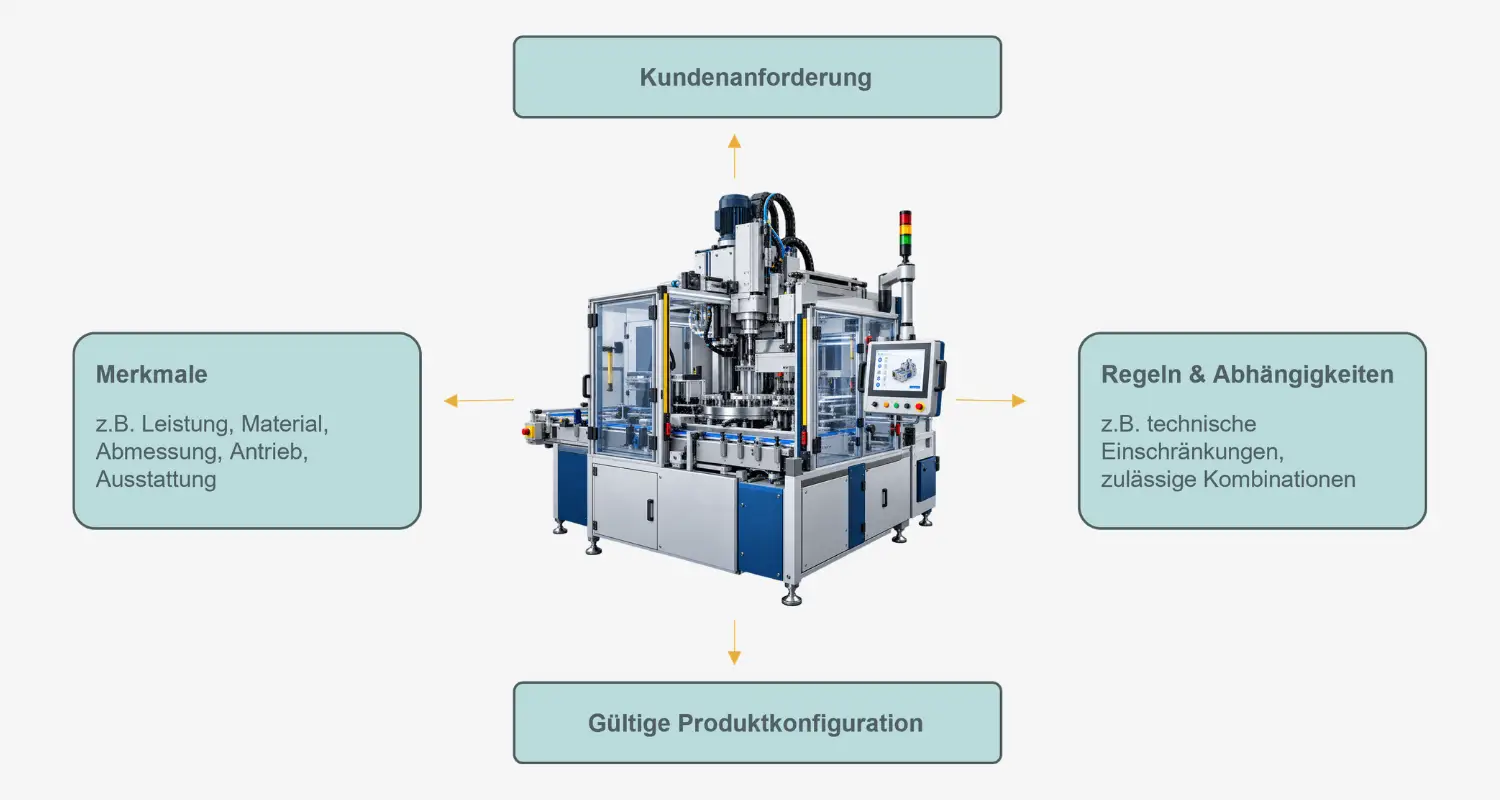
Instead, a configurable product is defined using characteristics, characteristic values, product structures, and rules. A valid product configuration is generated from a combination of this information, tailored to specific customer requirements.
For example, a product might be defined by characteristics such as performance, dimensions, material, drive system, or equipment options. Rules and dependencies ensure that only valid combinations are created.
In this way, SAP Variant Configuration links individual customer requirements with the company’s existing product knowledge and the subsequent sales, order, and production processes.
How does SAP variant configuration work?
Characteristics and characteristic values
Attributes describe the characteristics of a product—such as performance, material, dimensions, or color. Attribute values define the specific possible variations.
Classes
Classes group and structure characteristics. In SAP variant configuration, variant classes form an important basis for describing configurable materials.
Configurable materials
A configurable material represents products whose specific form emerges only through the selection and derivation of corresponding characteristic values.
Relationship knowledge
Relationship knowledge maps the rules and dependencies of the product. This is used, for example, to derive values, exclude combinations, or select components.
Bills of materials
Depending on the specific configuration, the required components and assemblies can be determined automatically.
Work schedules
Manufacturing steps, too, can depend on the specific product configuration and consequently feed into downstream processes.
What advantages does SAP Variant Configuration offer?
Reduced master data complexity
Product variants are described using a rule-based model, rather than mapping every theoretically possible combination separately.
Higher configuration reliability
Product rules help to rule out technically impermissible combinations during the configuration process itself.
Faster sales processes
Sales staff can configure complex products in a structured manner and transfer the configuration into downstream quotation and order processes.
Automated follow-up processes
The configuration provides information relevant to subsequent processes such as planning and manufacturing.
Centralized product knowledge
Technical product knowledge is represented in a structured manner within the product model, thereby making it usable across departmental and process boundaries.
SAP LO-VC or SAP Advanced Variant Configuration (AVC)?
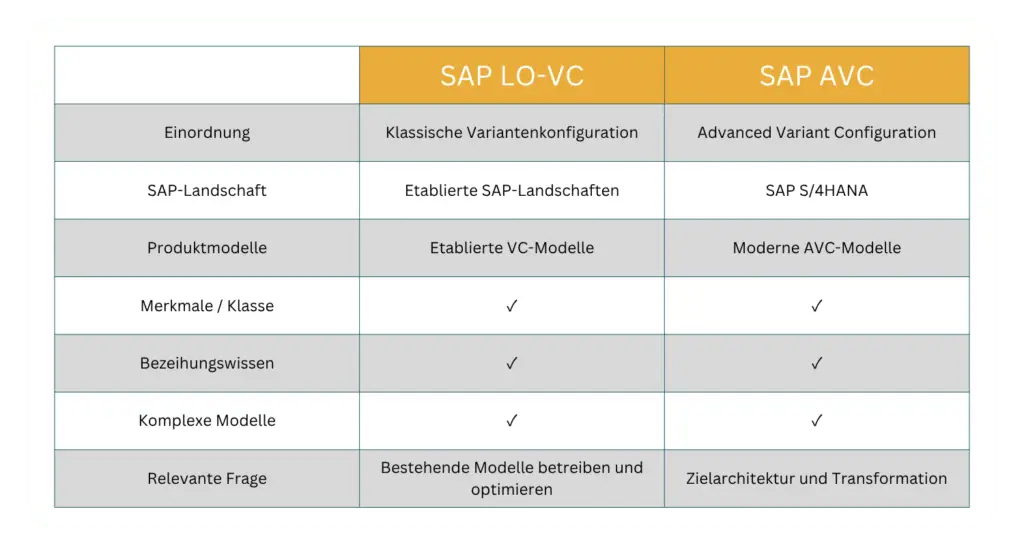
Anyone dealing with SAP variant configuration today encounters two terms in particular: classic SAP Variant Configuration (LO-VC) and SAP Advanced Variant Configuration (AVC) within the S/4HANA environment.
SAP Advanced Variant Configuration in S/4HANA
SAP Advanced Variant Configuration—or AVC for short—represents the modern approach to variant configuration within the SAP S/4HANA environment.
For companies with an existing LO-VC landscape, the transition involves more than just a technical upgrade; it offers an opportunity to fundamentally review existing product models, dependency knowledge, processes, and integrations.
AVC becomes particularly relevant when variant configuration is intended to serve as the central product logic within end-to-end processes.

SAP variant configuration end-to-end
A central product model makes product knowledge available across the entire value chain. Characteristics, rules, and dependencies are not recreated for each sales channel or process but are used consistently across various application scenarios.
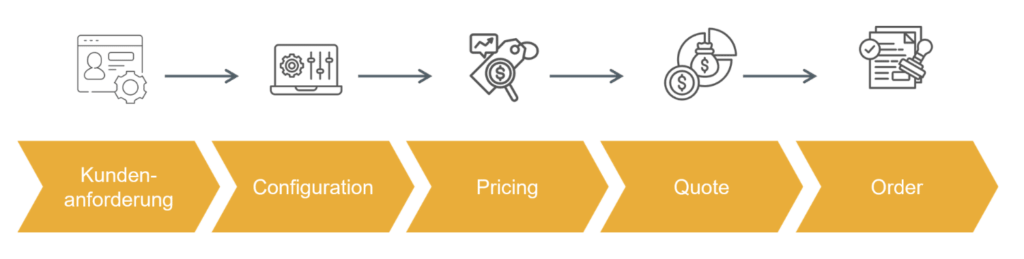
For complex products, the sales team needs to know not only what the customer wants but also whether a specific product variant is technically feasible, which options are compatible, and the price at which it can be offered.
This is where variant configuration and Configure-Price-Quote (CPQ) processes intersect.
By integrating SAP Variant Configuration and SAP CPQ, product configuration, pricing, and quotation generation can be combined into a seamless sales process.
You are migrating to S/4HANA. What happens to your variant configuration?
After all, these product models often embody decades of accumulated corporate and product knowledge. At the same time, however, structures that have evolved over time, complex relational logic, and custom extensions can complicate the transformation process.
- How well-structured are our current models?
- What relationship knowledge can be adopted?
- Where should models be optimized beforehand?
- Which processes should use AVC in the future?
- What does our future configuration architecture look like?
Our Services for SAP Variant Configuration
Strategy & Architecture
Configuration strategy for end-to-end configuration processes.
Modeling
Structure product models and relational knowledge.
SAP LO-VC
Analysis, optimization, and further development of existing models.
SAP AVC
Design and implementation in SAP S/4HANA.
Transformation
From LO-VC to AVC – with a clear strategy and implementation model.
Integration
CPQ, S/4HANA, Commerce, and other systems.
Frequently asked questions answered quickly.
What is SAP Variant Configuration?
SAP Variant Configuration enables the modeling of complex products with many variants within the SAP system. Products are defined using characteristics, characteristic values, product structures, and rules, allowing a technically valid product variant to be generated from a multitude of possible combinations.
What does SAP LO-VC mean?
SAP LO-VC stands for “Logistics Variant Configuration” and is the classic SAP solution for variant configuration. It has been used for many years to model configurable products and their dependencies within SAP.
What is SAP Advanced Variant Configuration?
SAP AVC stands for “Advanced Variant Configuration” and is the modern variant configuration solution for SAP S/4HANA. AVC builds upon proven SAP variant configuration concepts and is designed for modern S/4HANA and end-to-end scenarios.
What is the difference between LO-VC and AVC?
LO-VC is the classic SAP variant configuration, whereas AVC was developed for modern variant configuration processes in SAP S/4HANA. Many fundamental modeling concepts are comparable, yet they differ in terms of functionality, technical implementation, and integration.
Does LO-VC need to be replaced by AVC?
Not necessarily. Whether and when a transformation from LO-VC to AVC makes sense or is required depends on the existing system landscape, product models, processes, and the company’s S/4HANA strategy.
What master data does SAP Variant Configuration require?
Key elements include, among others, configurable materials, characteristics and characteristic values, classes, and configuration profiles, as well as product structures such as bills of material and routings. Dependency knowledge links these elements through rules and dependencies.
What is relational knowledge?
Relationship knowledge describes rules and dependencies within a configurable product. It can be used, for example, to control which options can be combined, which values are automatically derived, or which components are required for a specific configuration.
How is relationship knowledge modeled?
Relational knowledge is modeled using rules, conditions, and constraints that define the permissible combinations of characteristic values. This ensures that only product variants that make sense from both technical and business perspectives can be configured.
How do features and classes work?
Characteristics describe the attributes of a configurable product, such as performance, size, material, or color. Classes structure and group these characteristics, thereby forming an important foundation for product configuration.
How are SAP Variant Configuration and SAP CPQ related?
SAP Variant Configuration models the technical product logic and permissible product variants. SAP CPQ supports the sales-oriented Configure-Price-Quote process and can leverage this product logic to generate configurable quotes—and subsequently orders—based on customer requirements.
How does a transformation from LO-VC to AVC begin?
The process should begin with a structured analysis of existing LO-VC models, configuration knowledge, processes, and the system landscape. Based on this, it is possible to evaluate which models should be adopted, adapted, or optimized, and what a suitable AVC transformation strategy looks like.
How can we support your SAP Variant Configuration?
Do you want to optimize your existing variant configuration, are you facing an S/4HANA transformation, or are you planning to implement SAP AVC?
Talk to our specialists about your current situation.