
From SAP LO-VC to SAP AVC – Transforming your variant configuration for the future
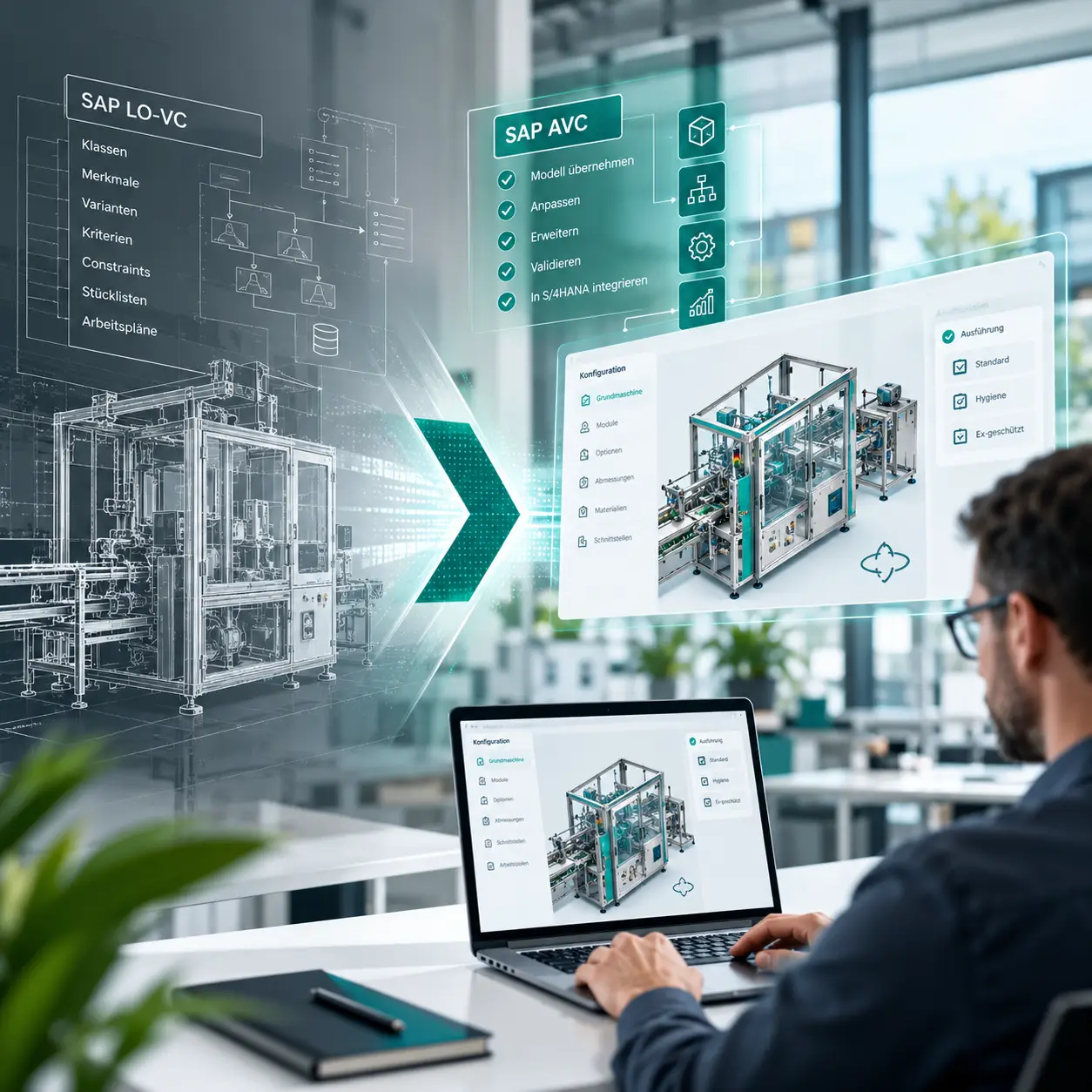
The transition from SAP LO-VC to SAP Advanced Variant Configuration (AVC) is more than just a change in technology. It offers an opportunity to further develop existing product models, standardize configuration processes, and unlock new potential within SAP S/4HANA.
networker variant supports you every step of the way—from analyzing your current LO-VC landscape and managing the technical and functional transformation, to integrating the solution into end-to-end sales, order, and production processes.
Leverage existing knowledge
Targeted adoption and further development of product models
Securing the transformation
Identify risks early and test in a structured manner
Think end-to-end
Connecting configuration and business processes
Preserve existing product models. Unlock new opportunities.
Many companies have spent years building extensive LO-VC models. These contain valuable product knowledge, business rules, and dependencies. Consequently, modernizing an SAP landscape is not about developing everything from scratch, but rather about effectively integrating proven structures with the capabilities offered by SAP AVC.
Future-oriented SAP architecture
SAP AVC opens up new possibilities within SAP S/4HANA and supports the further development of configuration-based business processes.
Acquire product knowledge
Existing features, classes, rules, and dependencies form the starting point. A systematic assessment is conducted to determine which content can be adopted or adapted.
Design end-to-end processes
The transformation makes it possible to consider configuration and downstream processes in sales, order processing, and production in an integrated manner.
Mastering technical complexity
Early-stage analyses, model testing, and an appropriate transformation strategy reduce uncertainties and facilitate the transition.
Greater flexibility and improved integration
SAP AVC is the modern configuration engine for SAP S/4HANA, opening up new possibilities for the further development of complex variant configuration processes. Benefit from advanced modeling capabilities, modern user interfaces, and additional integration options within your SAP system landscape.
| Betrachtung | SAP LO-VC | SAP AVC |
|---|---|---|
| Einordnung | Klassische Variantenkonfiguration | Moderne Konfigurations-Engine in SAP S/4HANA |
| Bestehende Modelle | Langjährig gewachsene Modelllandschaften | Übernahme nach Prüfung und Anpassung |
| Modelllogik | Klassische Abhängigkeiten und Constraints | Erweiterte Modellierungs- und Auswertungsmöglichkeiten |
| Integration | Bewährte SAP-Prozessintegration | Zusätzliche Möglichkeiten in S/4HANA-Szenarien |
| Transformation | Ausgangsbasis mit vorhandenem Produktwissen | Zielarchitektur mit Anforderungen an Tests und Validierung |
From SAP LO-VC to SAP AVC in six steps
A successful transformation begins with transparency regarding the existing configuration landscape. Our structured approach combines technical analysis, functional planning, implementation, and quality assurance.
1
Strategic Scoping
Analysis, Target State & Areas for Action
Result: Initial Analysis
2
Holistic Planning
Project Scope, Priorities & Transformation Plan
Deliverable: Transformation Plan
3
Implementation
Transfer & Optimization of Models
Result: Implemented AVC Models
4
SAP-compliant validation
Functional & process-related tests
Result: Documented test results
5
Controlled Go-Live
Transition & Risk Mitigation
Outcome: Go-live
6
Hypercare & Optimization
Stabilization & Further Development
Result: Stable Operation
Transformation roadmap as PDF
All six steps in detail.Download here now.
SAP AVC is not an isolated IT project – but rather part of your entire value chain.
Transformation yields the greatest benefit when configuration models are not merely modernized from a technical standpoint, but also integrated into related business processes.
For this reason, networker variant considers the entire process chain—from product modeling and customer-specific configuration to the creation of quotes and orders, as well as all subsequent processes.
Model
Product Knowledge and Rules
Configure
SAP AVC and Product Logic
Offer
SAP CPQ and Pricing
Process
Order and Production
Product modeling
Consistent rules and product data as the foundation for configuration.
Learn more about SAP Variant Configuration
Visualization & Configuration
Configure complex products in a clear and user-friendly way.
Learn more about SAP AVC
Sales & SAP CPQ
Connect configuration, pricing, and quotation generation.
Learn more about SAP CPQ
Every configuration landscape is different. Our approach takes this into account.
Existing LO-VC landscapes have often evolved over many years. They contain company-specific product logic, complex dependencies, and numerous interfaces. For this very reason, their transformation requires more than just a purely technical conversion.
- Complex Dependencies and Constraints We examine existing modeling logic, identify incompatibilities, and develop appropriate adjustments for SAP AVC.
- Variant tables and master data We take data quality, maintenance processes, and consistency into account, ensuring that existing product knowledge remains reliably usable even after the transformation.
- Custom extensions and interfaces Customer-specific developments and connected systems are evaluated at an early stage to reveal their impact on the target architecture.
- Tests and configuration results Systematic comparative tests help to identify and evaluate differences between previous and future configuration behavior.
SAP variant configuration is our area of specialization – from LO-VC to end-to-end processes.
A successful AVC transformation requires a deep understanding of existing LO-VC models, the technical capabilities of SAP AVC, and the processes in which configuration is applied.
networker variant combines these competencies with many years of experience in variant manufacturing. We look beyond the configuration engine itself, focusing instead on the interplay between product data, modeling, sales, order management, and production.
Specialized SAP expertise
In-depth knowledge of LO-VC, AVC, and complex product modeling.
Structured Transformation
A logical approach, spanning from the initial assessment to stabilization.
End-to-end understanding
Configuration in the context of SAP S/4HANA and related business processes.
Frequently Asked Questions About Transformation
Can existing LO-VC models be migrated to SAP AVC?
Many existing model components can serve as a foundation. Whether and to what extent adjustments are necessary depends on the modeling logic employed, individual extensions, and the relevant business processes.
Is a complete remodelling necessary?
Not necessarily. In many cases, a targeted further development of existing models makes more sense. The decision should be based on an analysis of the current configuration landscape.
Can SAP LO-VC and SAP AVC be used in parallel?
Depending on the system landscape, application scenario, and technical requirements, parallel deployment and transition scenarios are possible. These must be planned and evaluated on a project-specific basis.
How long does a transformation to SAP AVC take?
The effort involved depends, in particular, on the number and complexity of the product models, existing extensions, data quality, and the necessary process integrations. A reliable assessment is only possible after an initial inventory and evaluation.
Which transformation approach is the right one?
Brownfield, greenfield, and selective transformation approaches can be appropriate depending on the initial situation. Key factors include the existing system architecture, the quality of the product models, and the company’s strategic goals.
Start your journey now – we will accompany you on the path to SAP AVC
In an initial meeting, we will be happy to discuss your individual requirements and answer your questions about the transformation project.